 Seoul Private Tours
DMZ Tour from Seoul: The Complete Planning Guide

A DMZ tour from Seoul is the only way to reach the 3rd Infiltration Tunnel and Dora Observatory, which admit visitors solely on the official DMZ Peace Tour from Imjingak. The drive from central Seoul is 55.8 km and about 52 minutes by our route measurement, without traffic, so the whole day fits easily between breakfast and dinner. Below are the passport rule, the closed days, every stop in order and how Seoul private tours to the border compare with the shared coaches.
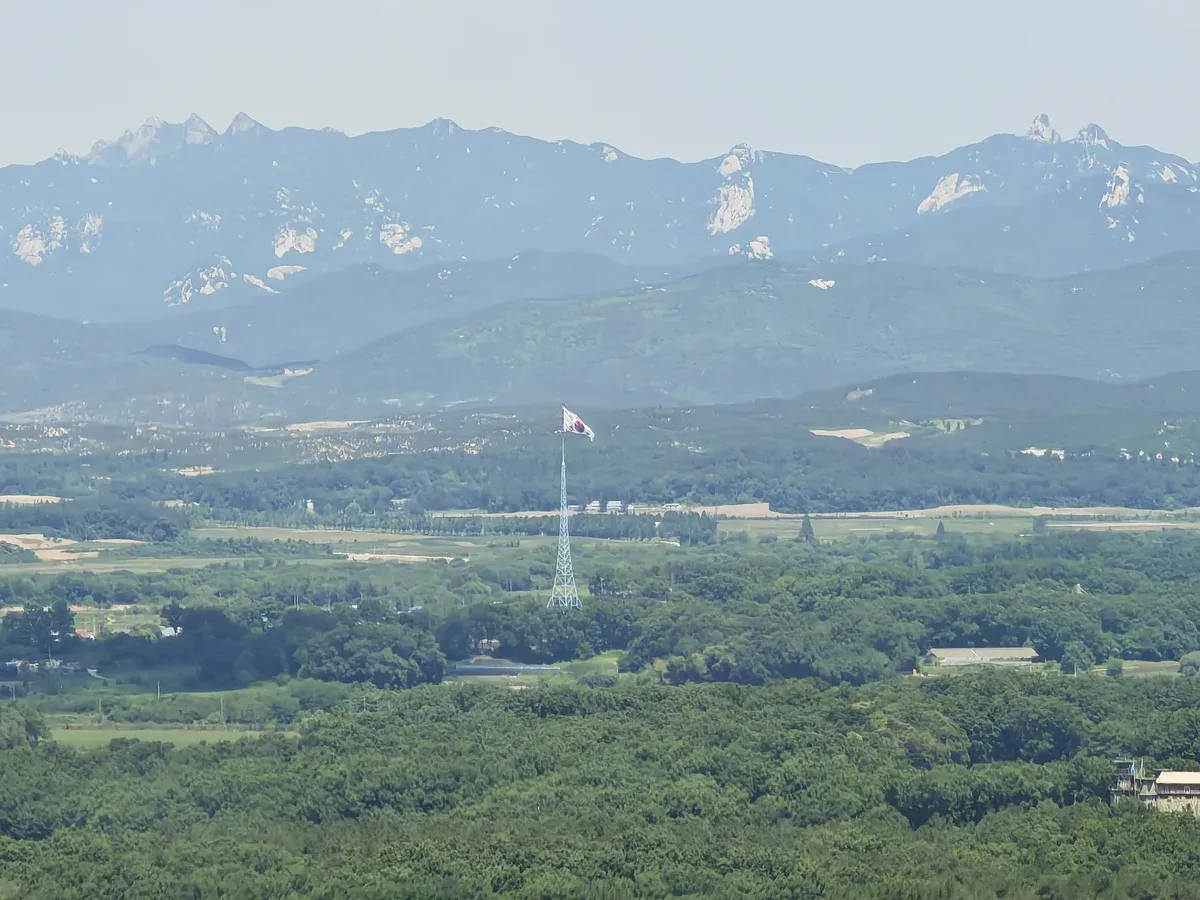
The view north from Dora Observatory. Photo: Dwxn, CC BY-SA 4.0, via Wikimedia Commons
Quick answer The DMZ day in four sentences
A DMZ tour from Seoul takes 6 to 9 hours door to door and covers Imjingak, the 3rd Infiltration Tunnel, Dora Observatory and often Dorasan Station. You cannot visit those stops alone, because Dora Observatory is reached only through the DMZ Peace Tour after reservation. Bring a physical passport, avoid Mondays and weekday public holidays, and expect the zone to close at short notice for military reasons with no refund. Inside the zone every group, private or not, rides the designated military bus.
Key takeaways
- Best for questions and pace: private DMZ day with a defector talk
- Shortest option: private half-day with hotel pickup and admission included
- Want the former US base? See the semi-private Camp Greaves and gondola day
- The JSA at Panmunjom is closed to the public, so no tour from Seoul includes it
- Imjingak Park is free to walk without any ticket or passport check
Private DMZ Tours from Seoul
Private and semi-private DMZ days from Seoul, from a half-day to a full day with a bridge or Camp Greaves. Inside the zone every group, whatever the booking type, rides the designated military bus with its guide, because private vehicles cannot enter.
Why the DMZ Needs a Tour
The Civilian Control Line
North of Imjingak the road passes through a civilian control line, and beyond it only registered visitors may travel. Dora Observatory sits in a Civilian Restricted Area and cannot be visited individually, since Visit Korea states it is reached only through the DMZ Peace Tour, which departs from the Imjingak pavilion after reservation. The same applies to the 3rd Infiltration Tunnel, where you buy a Peace Tourism ticket at the Imjingak office and travel by the tour bus.
At the Unification Bridge checkpoint, just past the river, passports are examined before the bus enters the zone. Only Imjingak Park itself, with the Freedom Bridge memorials, is freely open to everyone without a ticket.
- Your physical passport, for every traveller
- Comfortable closed shoes for the steep tunnel incline
- Smart casual clothing, which some operators ask for
- Cash or card for the tunnel tram if you do not want to walk
- A light layer, the tunnel stays cool in summer
Passports and Booking Details
A passport or Alien Registration Card is required for the Dora Observatory and the Peace Tour, and entry is refused without identification. Operators differ on paperwork. On the private day with a defector talk you must supply the passport name, number, expiry and country for all participants at the time of booking, then carry the original on the day.
On the half-day card you do not need to send a copy in advance, only bring it on the day. Children aged 3 and over pay adult prices on both private operators, while infants sit on an adult's lap.
- Passport required on the day, the original rather than a photo
- Some operators want full passport details at booking
- Ages 3 to 99 pay adult price, infants ride on a lap
Closed Days and Sudden Closures
The Peace Tour through the tunnel, Dora and Dorasan closes every Monday, on public holidays that fall on weekdays, and on Seollal and Chuseok. Camp Greaves adds 1 January to that list. Military reasons can close the zone with no warning at all.
After North Korea demolished two connecting roads in 2024, Dora Observatory was shut for about a day, and observatories have been dropped from itineraries at short notice in other years too. Operator terms are blunt: if the military closes a stop, an alternative is offered and there is no refund, so build flexibility into your Seoul plans.
- Closed every Monday, weekday public holidays, Seollal and Chuseok
- Camp Greaves also closes 1 January
- Military closures happen without notice and carry no refund
- Pick the gondola, bridges or Imjingak as backup, they sit outside the closed zone
The Stops, in Order
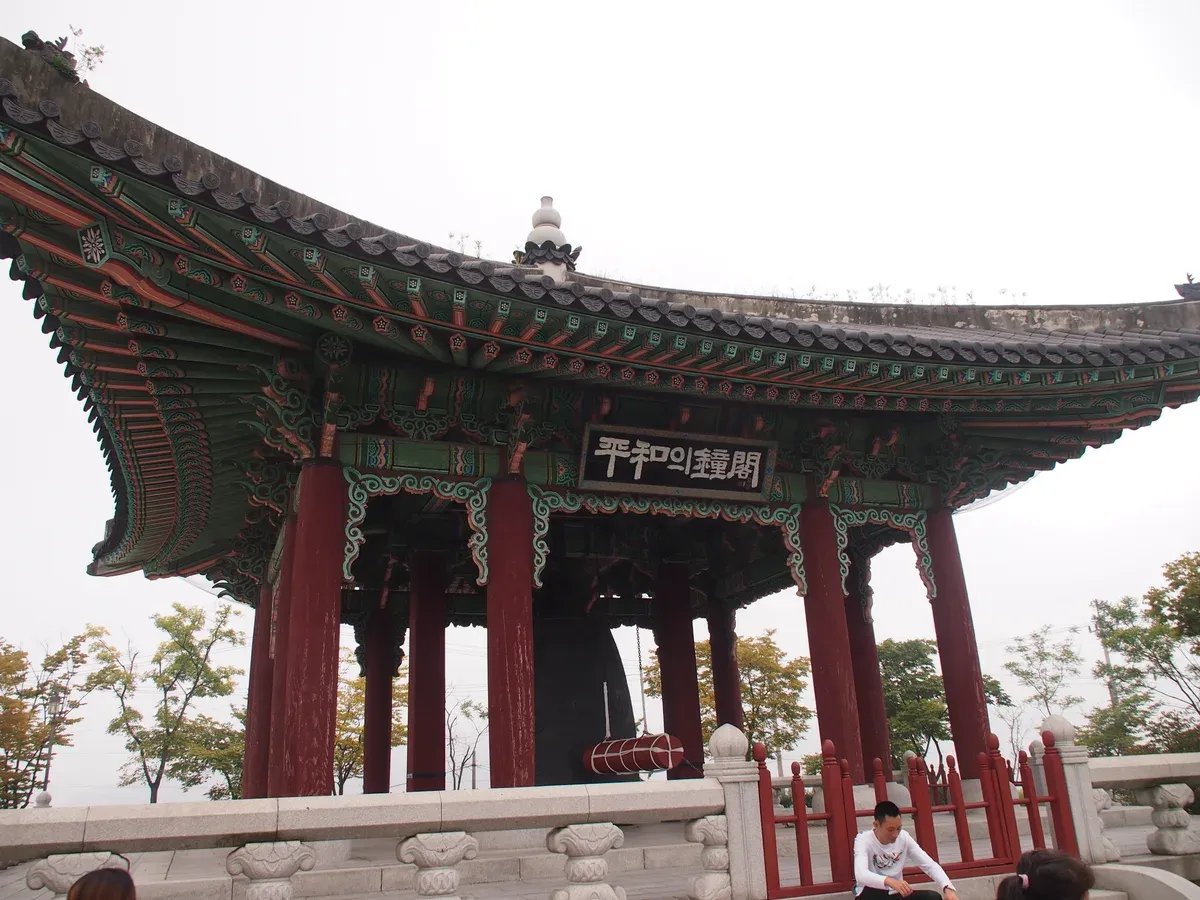
The Peace Bell at Imjingak. Photo: Kaz Ish, CC BY-SA 3.0, via Wikimedia Commons
Imjingak and Freedom Bridge
Imjingak Park was built in 1972 to console families separated by the division and now draws about 1.2 million visitors a year. The Freedom Bridge beside it, built in 1953 for the exchange of 12,773 Korean War prisoners, served as the main DMZ access point until 1998 and a section is open to walk. On the park lawn stands the Peace Train, a steam locomotive shot to a standstill at Hanpo on the last day of 1950 and left rusting with more than a thousand bullet holes, given cultural heritage status in 2004.
This is also where the Peace Tour ticket office opens from 09:00, with the first bus leaving 09:20 and ticketing able to close early.
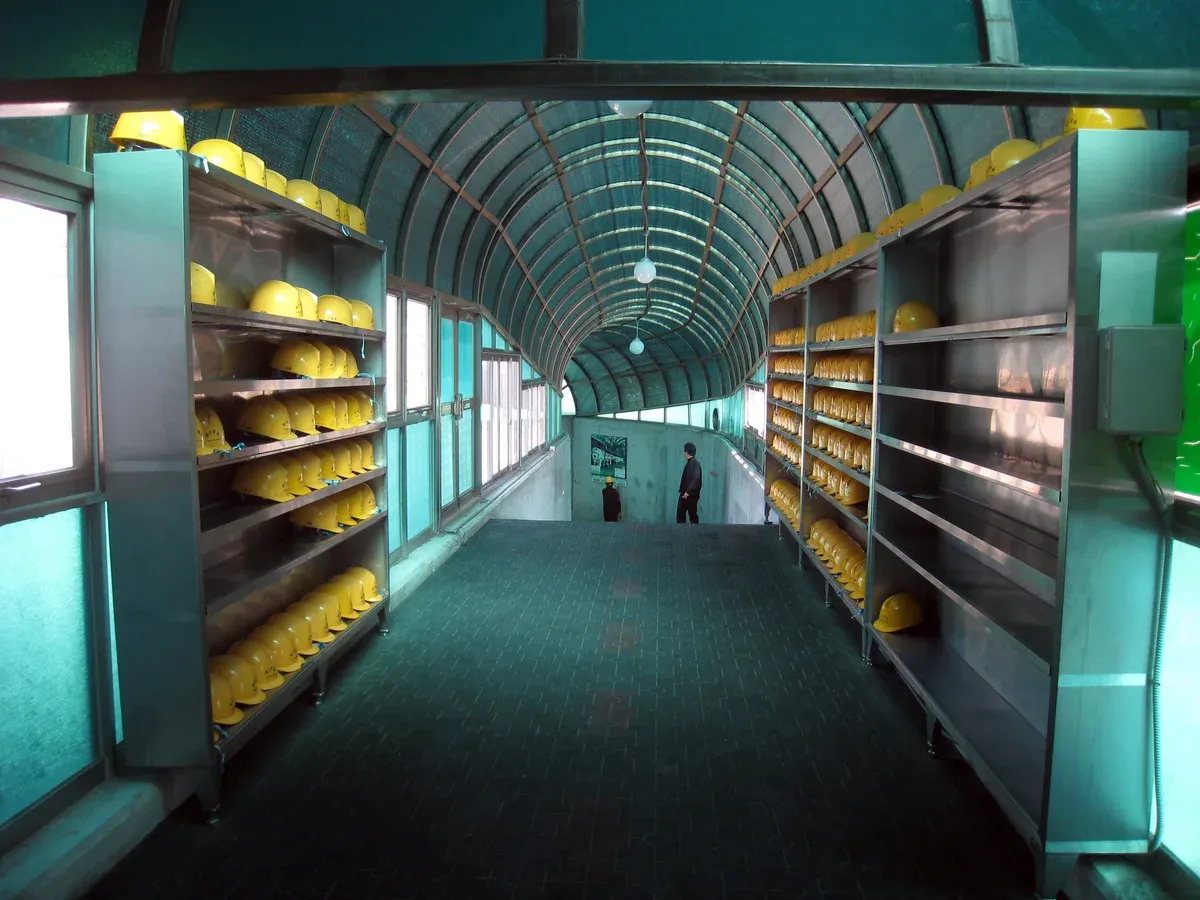
Helmets wait at the tunnel entrance. Photo: Josh Berglund, CC BY 2.0, via Wikimedia Commons
The 3rd Infiltration Tunnel
The tunnel was discovered in 1978 after an explosion and water gushing from a borehole gave it away, following a defector's tip two years earlier. It runs 1,635 m through granite about 73 m below ground, up to 1.95 m high and 2.1 m wide, wide enough to move 30,000 soldiers an hour with light weapons. Visitors descend a steep, cramped incline on foot or ride a rubber-tyred train, and only part of the passage is open, ending at the third of three concrete barricades on the Military Demarcation Line.
Photography is prohibited inside, with phones and bags stored in lockers at the entrance. Wear shoes you can trust, because the slope is slippery in places.
- Discovered in 1978, 1,635 m long, about 73 m deep
- Walk down or take the rubber-tyred train
- No photos anywhere on the tunnel course, lockers at the entrance
Dora Observatory and Dorasan Station
Dora Observatory opens 10:00 to 17:00 and closed Mondays, in a new three-storey building that opened in 2024 with an indoor amphitheatre and cafe. From the viewing floor you can pick out Panmunjeom, the DMZ village of Daeseong-dong, North Korean farmland and mountains and the city of Gaeseong, some through binoculars. Photos are taken only where your guide says, and the observatory can be dropped from an itinerary at short notice.
Dorasan Station, opened in 2002 about 650 m from the southern boundary of the DMZ, has never run cross-border passenger service, and freight stopped after North Korea demolished the connecting tracks in 2024.
| Stop | Fee | Note |
|---|---|---|
| Imjingak Park | Free | Open access, no passport needed |
| Peace Tour ticket office | Opens 09:00, sales to 14:30 | First bus 09:20 |
| 3rd Tunnel, walking | $6.76 (₩9,200) adult | $5.14 (₩7,000) youth, $4.55 (₩6,200) senior |
| 3rd Tunnel, with elevator | $8.96 (₩12,200) adult | $6.98 (₩9,500) youth, $5.66 (₩7,700) senior |
| Dora Observatory | 10:00-17:00 | Closed Mondays |
| Peace Gondola, round trip | $8.82 (₩12,000) adult standard cabin | $11.02 (₩15,000) crystal cabin |
| Camp Greaves Gallery Greaves | $2.20 (₩3,000) adult for gondola holders | Five guided sessions a day, closed Mondays |
| Gamaksan Suspension Bridge | Free | Open sunrise to sunset all year |
| Majang Lake bridge | Free | 09:00-18:00 March to October, 09:00-17:00 November to February |
The Add-On Stops
The Peace Gondola opened in 2020 and lifts you about 50 m above the Imjin River in a ride of roughly 8 minutes one way, running weekdays 09:00 to 18:00 and to 19:00 on weekends and holidays. It carries you from Imjingak to Camp Greaves, a base that housed the US Army's 2nd Infantry Division for about 50 years after the 1953 ceasefire and was returned to Seoul in 2007, now a peace experience site with exhibitions in a former bowling alley. The gondola stays inside the Civilian Control Zone and does not enter the DMZ.
Away from the river, the 150 m Gamaksan Suspension Bridge and the 220 m Majang Lake bridge are both free and popular with families who want a walk after the tunnel.
See the Day Before You Book
The JSA and Panmunjom
Closed Since 2023
The Joint Security Area at Panmunjom is closed to the public since 2023, after a US soldier crossed the border during a tour. Civilian visits have not returned, apart from a single special tour for unification trainees, and access is now limited to military officials, distinguished visitors and media. No date for general public tours has been published.
If any listing from Seoul advertises a JSA or Panmunjom inclusion, treat it as false, because no operator can put tourists there at present.
What the Cards Actually Cover
Every tour on this page states plainly that it is a DMZ tour and not the JSA, which is the honest framing. What you get instead is the DMZ itself: the tunnel, the observatory, Dorasan and the Imjin River sites, all of which are open and running. The JSA Museum and exhibition spaces along the route tell the Panmunjom story in photographs and artefacts, but they are exhibition halls, not the blue huts themselves.
If the JSA is your only reason for coming, wait for an official reopening announcement rather than booking a rebranded DMZ day.
Private, Semi-Private or Shared
What Private Actually Buys You
Hotel pickup anywhere in Seoul, a guide who stays with you all day, and a pace you set, which matters most in the tunnel and at the observatory where big coaches move in blocks. What private does not buy is exclusivity inside the zone: every group rides the designated military bus together, because private vehicles cannot enter. Guides also queue early at Imjingak for Peace Tour passes, since companies cannot reserve tickets in bulk, which is why departures start around 8am.
A shared coach is cheaper per person. The table below sets the private and semi-private days side by side by price, length and the stop that makes each one different.
| Tour | Price | Length | Extra stop |
|---|---|---|---|
| Private day with defector talk | $198 per person | 8 - 9 hours | Gamaksan or Majang bridge, defector talk |
| Semi-private Camp Greaves day | $229 per person | 8 hours | Peace Gondola and Camp Greaves |
| Private half-day with pickup | $270 per person | 6 hours | Admission included, no extra stop |
| Private tunnel and Gamaksan day | $474 per group of up to 2 | 9 hours | Gamaksan Suspension Bridge |
Timing and the Designated Bus
Our route measurement puts the drive north at 52 minutes without traffic, so allow longer once rush hour and a hotel pickup run are added. The Peace Tour loop inside the zone takes about 3 hours for Imjingak, the tunnel, Dora, Dorasan and Unification Village, which is why the half-day card needs 6 hours and the full days run 8 to 9. The half-day starts at 8am unless you ask the guide 24 hours ahead for a later start.
On the full days expect pickup to begin 30 to 60 minutes before the stated departure time.
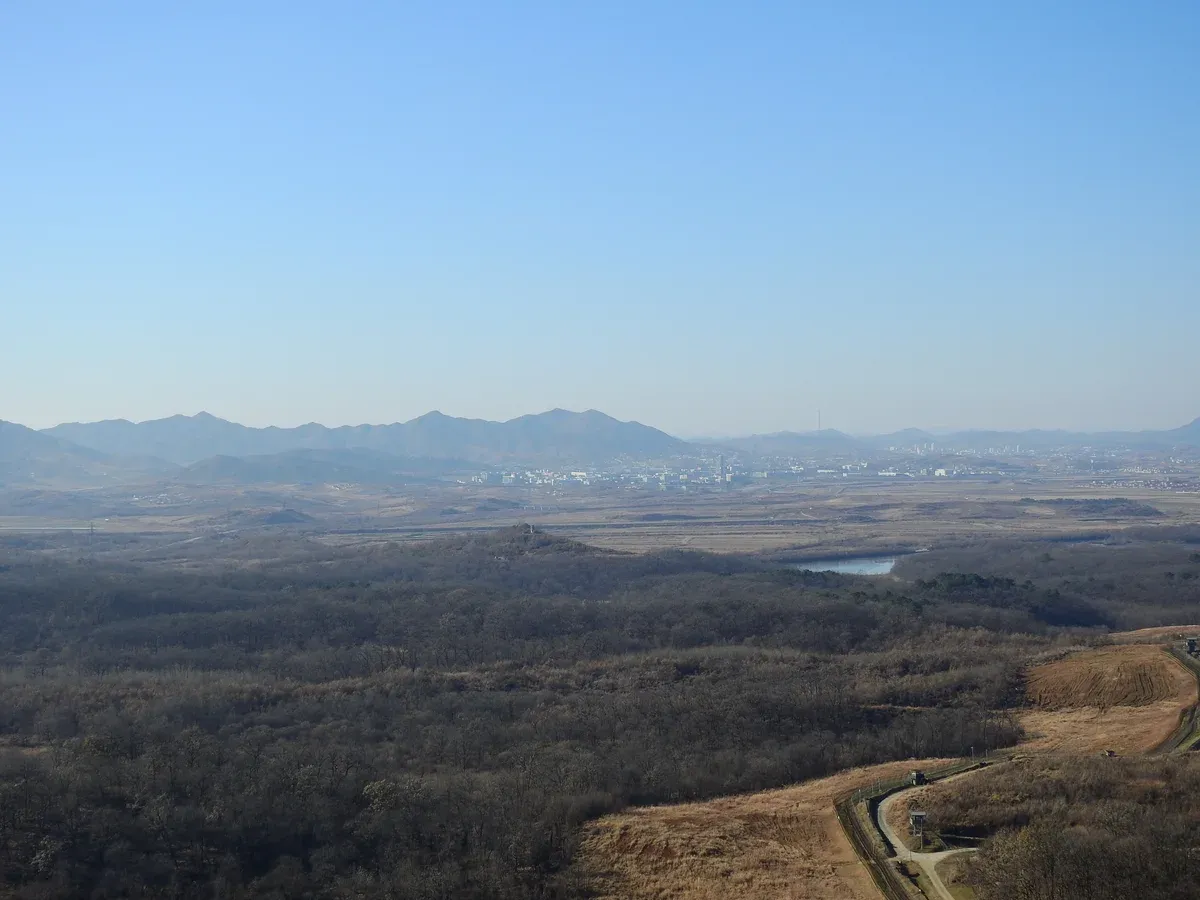
Late November from the observatory, looking north. Photo: Huntsmanleader, CC BY-SA 4.0, via Wikimedia Commons
Which DMZ Day Fits You
If You want to hear from someone who lived in the North
Book the private day with a defector talk and Q&A, from $198 per person with a suspension bridge after the DMZ.
If You want a former US Army base on the itinerary
Take the semi-private Camp Greaves and Peace Gondola day, the only card that crosses the Imjin River by cable car.
If You want the border in a morning and the afternoon free
Choose the private half-day with admission included, 6 hours with hotel pickup from $270 per person.
If You are a small group splitting one price
Pick the private 3rd Tunnel and Gamaksan bridge day at $474 per group of up to 2, with admissions, fuel, tolls and parking included.
The DMZ Route on the Map
The places this page talks about, pinned. Tap a pin for directions.
DMZ Tour Questions
Is the DMZ tour worth it from Seoul?
Yes, for history you cannot get anywhere else. The 3rd Infiltration Tunnel, dug 73 m under the border and able to move 30,000 soldiers an hour, is walked with your own feet. Dora Observatory looks across at Gaeseong and the DMZ villages, and Freedom Bridge carried 12,773 prisoners home in 1953. Go in knowing it is a security-managed day, the JSA is closed to the public, and any stop can be dropped if the military decides so that morning.
How long is a DMZ tour from Seoul?
Door to door, count on 6 hours for the private half-day and 8 to 9 hours for the full days with a bridge or Camp Greaves added. The drive from central Seoul to Imjingak is 55.8 km and about 52 minutes by our route measurement, without traffic, longer at rush hour. Inside the zone the Peace Tour bus loop takes about 3 hours across the tunnel, observatory, Dorasan and Unification Village. Morning departures around 8am are the norm because guides queue early for tickets.
What is the best DMZ tour from Seoul?
It depends on the day you want. For questions and a personal pace, the private day with a defector talk is the strongest pick. For the shortest option, take the private half-day with hotel pickup, which includes admission. For something different, the semi-private Camp Greaves and gondola day adds the Peace Gondola and a former US base. None of them includes the JSA, which has been closed to the public since 2023.
Can I go to the DMZ on my own?
Partly. Imjingak Park, with Freedom Bridge and the Peace Train, is open to everyone without a ticket, and independent visitors can also ride the Peace Gondola to Camp Greaves after completing an access form. But the 3rd Infiltration Tunnel and Dora Observatory are reachable only with a DMZ Peace Tour ticket bought at Imjingak, sold first come first served from 09:00 with your passport in hand. A DIY day is possible, though a guided tour saves the queueing and the transfer connections.
Is the JSA open to tourists?
No. Public JSA tours at Panmunjom have been closed to the public since 2023, with only a one-off tour for unification trainees since then, and access is now limited to military officials, distinguished visitors and media. No reopening date for general visitors has been published. Any Seoul tour advertising the JSA or the truce village should be treated as a plain DMZ tour with misleading wording, so check that the itinerary lists the tunnel, Dora Observatory and Dorasan instead.
What should I bring on a DMZ tour from Seoul?
Your physical passport is non-negotiable, since entry to the Peace Tour is denied without identification. Wear smart casual clothes and sturdy closed shoes for the steep, narrow tunnel incline. Bring a little cash or a card for the tunnel tram and the Camp Greaves gallery fee if your tour does not include admission. Phones go into lockers inside the tunnel, so a small bag is easier than a big one.
Why do DMZ tours start so early?
Peace Tour tickets are sold first come, first served at the Imjingak ticket office, which opens at 09:00 with the first bus at 09:20. Tour companies cannot reserve seats in bulk, so guides queue for passes before their groups arrive, and late queues can land a midday entry slot. Operators also build in buffer, because the zone can close suddenly for military reasons with no refund, and an early start leaves room to reshuffle the day if that happens.
How much do the DMZ stops cost on the day?
The official Peace Tour admission is $6.76 (₩9,200) for adults walking down into the tunnel, or $8.96 (₩12,200) with the elevator, with lower youth and senior rates. The Peace Gondola round trip is $8.82 (₩12,000) in a standard cabin or $11.02 (₩15,000) in a crystal cabin, and the Camp Greaves gallery is $2.20 (₩3,000) for gondola holders. The Gamaksan and Majang Lake suspension bridges are both free. If you would rather pay one price up front, the private half-day with admission included folds the tunnel fee into the booking.